
Readiness
Know your AEDs are ready.
Ready when it counts.
An AED only helps if it is ready when needed. AED CheckTrac keeps the inspection records for your AEDs, including their pads and batteries, so you can see which AEDs have no current record, and share your records when someone asks. No evidence shows as unknown, never as ready.
AED CheckTrac records what was inspected and what evidence exists. It does not test devices or guarantee that an AED will work.
Readiness by AED
Illustrative, synthetic data- Gym lobby AEDInspected today, pads and battery recordedREADY
- Bus barn AEDPads expire in 21 daysAT RISK
- Field house AEDNo inspection record for 94 daysUNKNOWN
- Annex hallway AEDBattery reported failedNOT READY
1 AED with no evidence
Peace of mind
Peace of mind, with records to back it up.
AED rules and expectations vary by state and by facility. AED CheckTrac keeps the dated inspection records behind your program, so when an administrator, insurer or inspector asks, you have who inspected what, and when, to share.
What the research found
In reports to the FDA of AED failures in fatal events, battery and power problems made up about 23% of the failures, and about 5% of the malfunctioning devices were reported to have given a low-battery warning.
DeLuca et al., Annals of Emergency Medicine, 2012 (PubMed). FDA reports, 1993 to 2008. The authors note the reports are incomplete and a failure rate cannot be calculated.In annual inspections of more than 23,000 public AEDs in Seoul, South Korea, about 15% were found not ready to use, and most of those (about 84%) had expired electrodes.
Kim et al., Scientific Reports, 2022 (doi). One city, 2013 to 2017; sites that refused inspection were excluded. The study describes status, not cause.These studies are not about AED CheckTrac. They do not show that keeping records prevents failures.
See it in the product
What you will actually see.
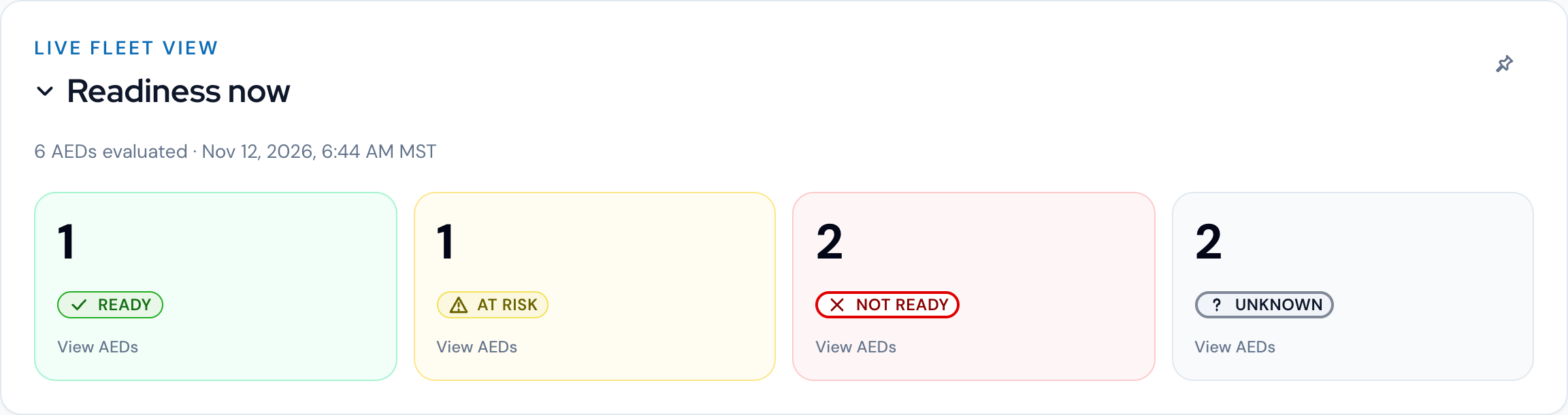
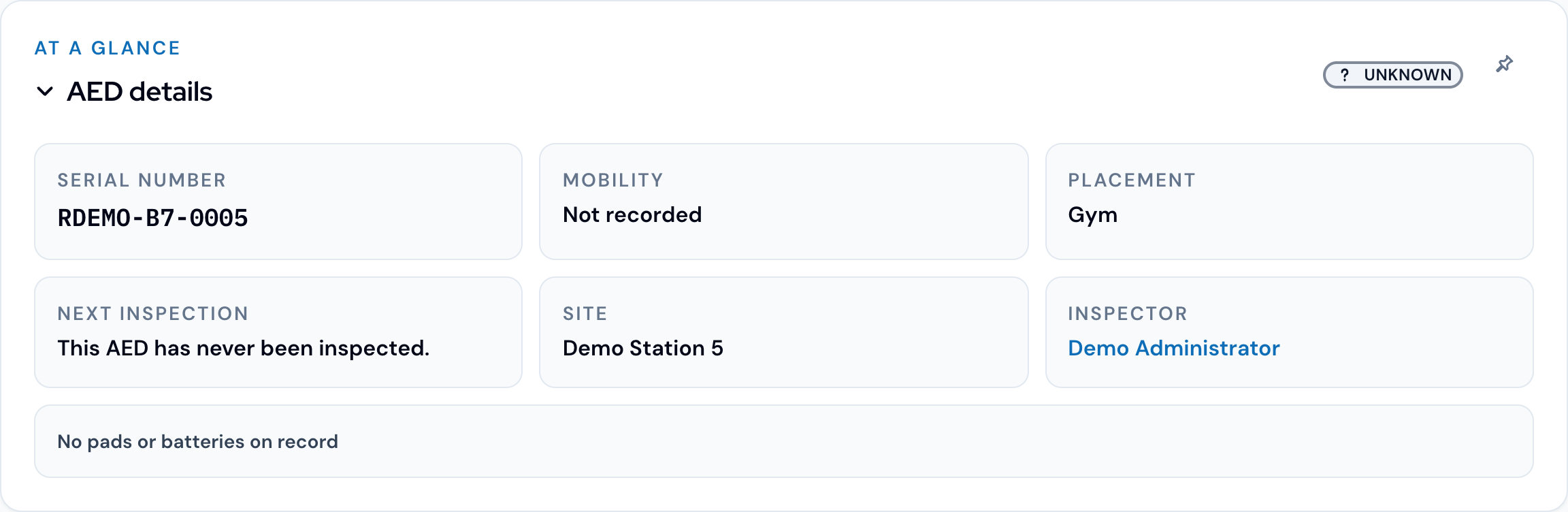
Screens from the product with made-up demonstration data. No customer information is shown. How it works
Three steps, and the gaps show themselves.
Inspect
A person walks up to the AED and records what they see.
Record
The evidence stays with that device, with who and when.
See what is missing
No evidence means UNKNOWN. It never rounds up to ready.
Questions you can answer today.
Which AEDs were inspected this month?
One list, by site, with the person and the date.
What is overdue or missing evidence?
Gaps are counted in your fleet view, not buried in a report.
Can I export all of it?
Yes. An administrator can export your records.
Built for schools and districts, public bodies, EMS and fire, and businesses with more than one site. Who it is for